
Over the past decade, private credit lenders didn’t just grow, they became the de facto lender to many of the middle market businesses in America. The transition created genuine value for borrowers and attractive income for investors. That rapid rise helped to bring private credit into the mainstream, and assets under management grew substantially. Between 2014 and 2024, the size of the private credit market roughly quadrupled, with total AUM growing from about $500 billion to over $2 trillion according to data from Pitchbook.
However, as capital flooded into private credit markets, the market is facing one of its first major tests. A look at recent headlines reveals a handful of high‑profile defaults, renewed questions about liquidity, and a narrative that “too much capital” entered the space and weakened underwriting discipline. With sentiment beginning to shift, it is fair to step back and assess the opportunities and risks across the private credit marketplace.
In this piece, we will begin with a brief overview of what private credit is and why it has grown into such a prominent asset class (you can find a more thorough overview in our primer). Then, we will shift our attention to today’s most pressing questions:
- Are high-profile defaults an early warning sign of systemic stress?
- Does the flood of new capital undermine returns?
We will address these questions directly as we seek to separate new risks from those that are simply becoming more visible as the market matures.
A Brief Introduction to Private Credit
The term “private credit” refers to financing that takes place outside of traditional public debt markets, where institutional investors such as alternative asset managers, business development companies (BDCs), and insurance companies provide loans directly to privately held businesses or against specific pools of assets. Unlike publicly traded bonds or syndicated loans, these transactions are negotiated individually, allowing lenders and borrowers to customize terms, covenants, and structures to the specific needs of the borrower.
The attractiveness of private credit is rooted in its flexible structure. The asset class offers borrowers greater certainty of deal closing, the ability to work with fewer lenders, and rapid execution. Getting deals done faster and with fewer lenders allows businesses to focus on growth rather than being bogged down in the process of securing financing. For lenders, it can be easier to implement protections and covenants that are tailored to the specific deal and help mitigate downside risks.
In recent years, private credit has become synonymous with direct lending, the largest segment of the market. However, the opportunity set now spans direct lending, asset-based and specialty finance, opportunistic and special situations, along with NAV financing. Please see our “Private Credit 101” primer for a deeper dive into the mechanics of the private credit market.
Are high-profile defaults an early warning sign of systemic stress?
Not yet. In September 2025, financial headlines zeroed in on two significant bankruptcies in the auto industry as a cautionary tale of systemic risk in private credit. The collapse of TriColor (a subprime auto lender and used-car retailer) and First Brands (an aftermarket auto parts supplier) were used to paint the narrative. What headlines and most articles missed, however, is that neither deal was technically originated in the private credit market. Both transactions were led by banks and not backed by private equity sponsors as is common in private credit transactions.
Around the same time, we saw pressure and headlines building around an adjacent industry known as Business Development Companies (BDCs), a publicly traded structure that lends money to small and medium-sized US businesses. BDCs are unique in that they pay out most of their profits as dividends and provide investors access to private loans that are typically inaccessible. BDCs sit at the crossroads of several late‑cycle credit dynamics:
- Tightening credit spreads
- Rising non‑accruals or defaults
- High refinancing activity squeezing interest income
- Falling interest rate expectations
Public filings show that as interest rates fell and competitive pressure rose, BDC portfolio yields drifted down. With the syndicated loan market becoming more active and banks moving aggressively, BDCs were forced to adjust terms to retain deals. Credit quality remains broadly sound, but non‑accruals are growing and dividend cuts led to price declines.
The resulting narrative raised questions about systemic risk and potential contagion, but the evidence so far points to pressure, not panic. Rated BDCs still exhibit conservative leverage, strong liquidity, and predominantly first‑lien portfolios (~89%), which supported stable outlooks across the sector. While high‑profile borrower failures (such as TriColor and First Brands) weighed on sentiment, these cases reflect poor governance and structural issues not exclusive to the private credit industry rather than deterioration across core middle‑market lending.
It is worth remembering that defaults are a regular occurrence in private credit and BDC structure because they are, by design, a higher return-seeking (and therefore risk-bearing) asset class. The private credit market lends to borrowers that are often smaller, more levered, or more operationally complex than the typical investment-grade rated issuer. In exchange for taking those risks and accepting less liquidity, investors are compensated with higher yields and an influential role in the underlying business. According to Proskauer, the private credit default rate was 2.5% in the fourth quarter of 2025, higher than in recent years but not necessarily alarming.
That framing matters because it clarifies an important point: the existence of defaults is not evidence that private credit “doesn’t work” or is near a precipice about to fall off the cliff. The relevant questions are where defaults occur, why they’re happening, and what recovery rates look like when problems arise. Private credit isn’t built to avoid every default; it’s built to price for risk, control it through structure, and recover capital effectively when a borrower stumbles.
Does the flood of new capital undermine returns?
Private credit emerged following the Global Financial Crisis, when regulatory changes aimed at curbing risk-taking in the banking system constrained the lending capacity of traditional banks. The tightened regulatory environment left the corporate community underserved in terms of access to financing and created an opportunity for private lenders to step in and fill the void, leading to growth in the asset class. Today, it is a core component of private markets and attracts capital from a wide range of investors.
Private credit’s expansion was not driven by excessive risk taking, but rather by a shortage of available bank capital. In a well-functioning economy, borrowers need reliable access to credit, and the post-GFC reforms pushed lending responsibility away from the banks and towards the private markets. In that context, investors should not confuse a larger market with a riskier one.
With that said, the attractiveness of private credit as an asset class is impacted by increased capital. Going forward, it will be important for investors to remain vigilant of any discrepancies that arise between supply and demand for loans. There are two primary risks that arise:
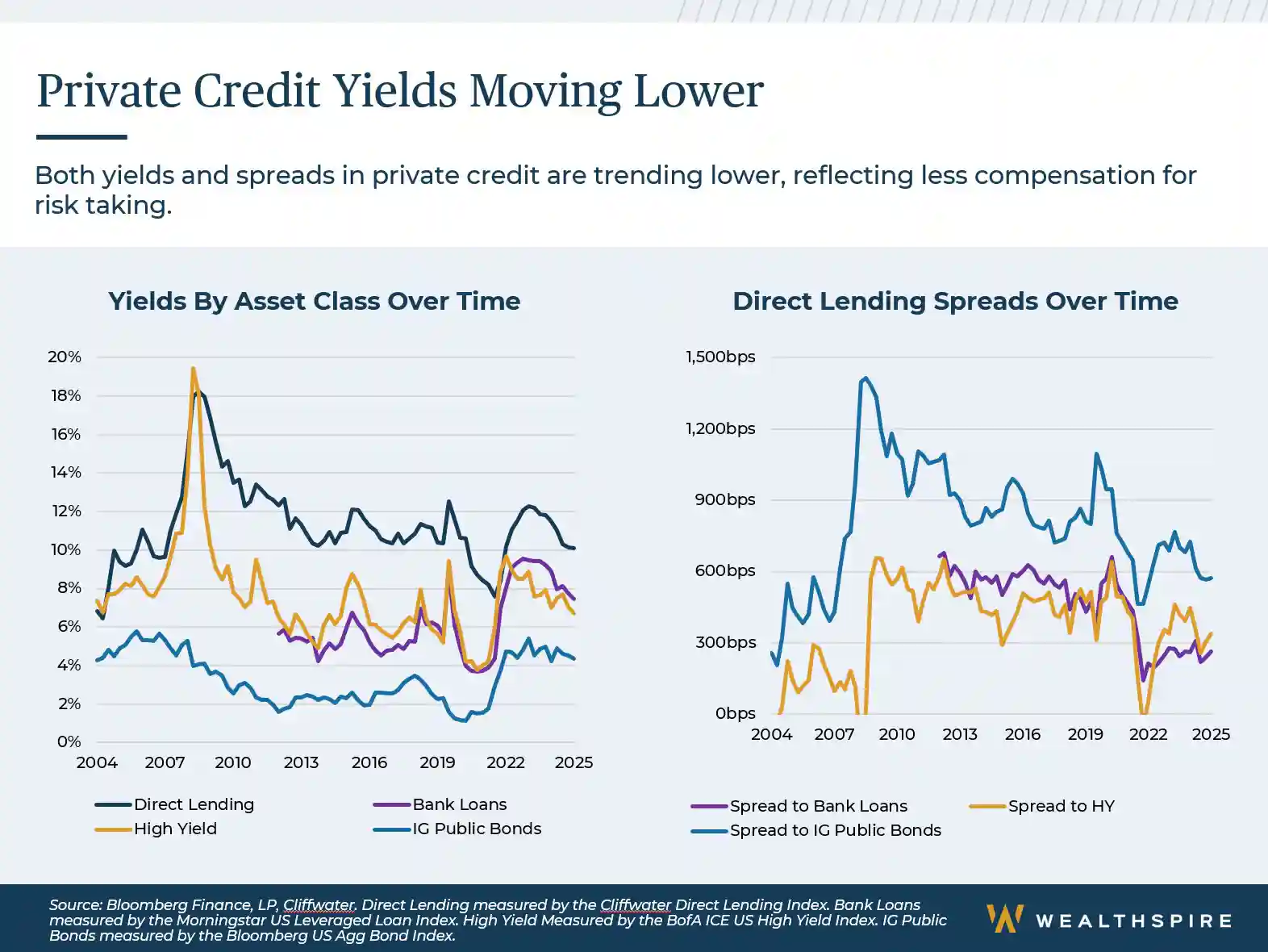
- Spreads: New issue direct lending spreads tightened materially in 2025 as seen in the chart below. Competition for lending compressed spreads from above 600 basis points in 2022 to below 500 basis points in 2025. Satellite credit is not as compelling today as in 2020-2022.
- Underwriting: standards deteriorate as lenders find it increasingly difficult to deploy capital in a timely fashion.
We saw evidence of spread tightening in corporate lending over the past couple of years, and the compensation investors receive for risk taking continues to decline. The charts below illustrate the downward shift in yields and spreads. As the absolute level of income shifted lower, so did the excess yield that private credit offered in comparison to public fixed income.
Underwriting standards are tricky to assess in real time, but analysts often point to the increased usage of Payment-In-Kind (PIK) structures as a potential signal of underlying weakness. PIK is a loan structure where some or all interest on the loan is not paid in cash each period but is instead added to the loan balance and accrues to the principal. PIK allows borrower flexibility (smaller payments) in the near-term, but increases the total interest owed on the loan over its full life. In recent years, PIK structures became increasingly common in private credit, prompting speculation of a decline in credit quality. According to data from Lincoln International, the percentage of investments with PIK increased from 7% to 11% over the past four years, and in many cases, the PIK feature was added as an amendment to the loan structure (see graphic below).
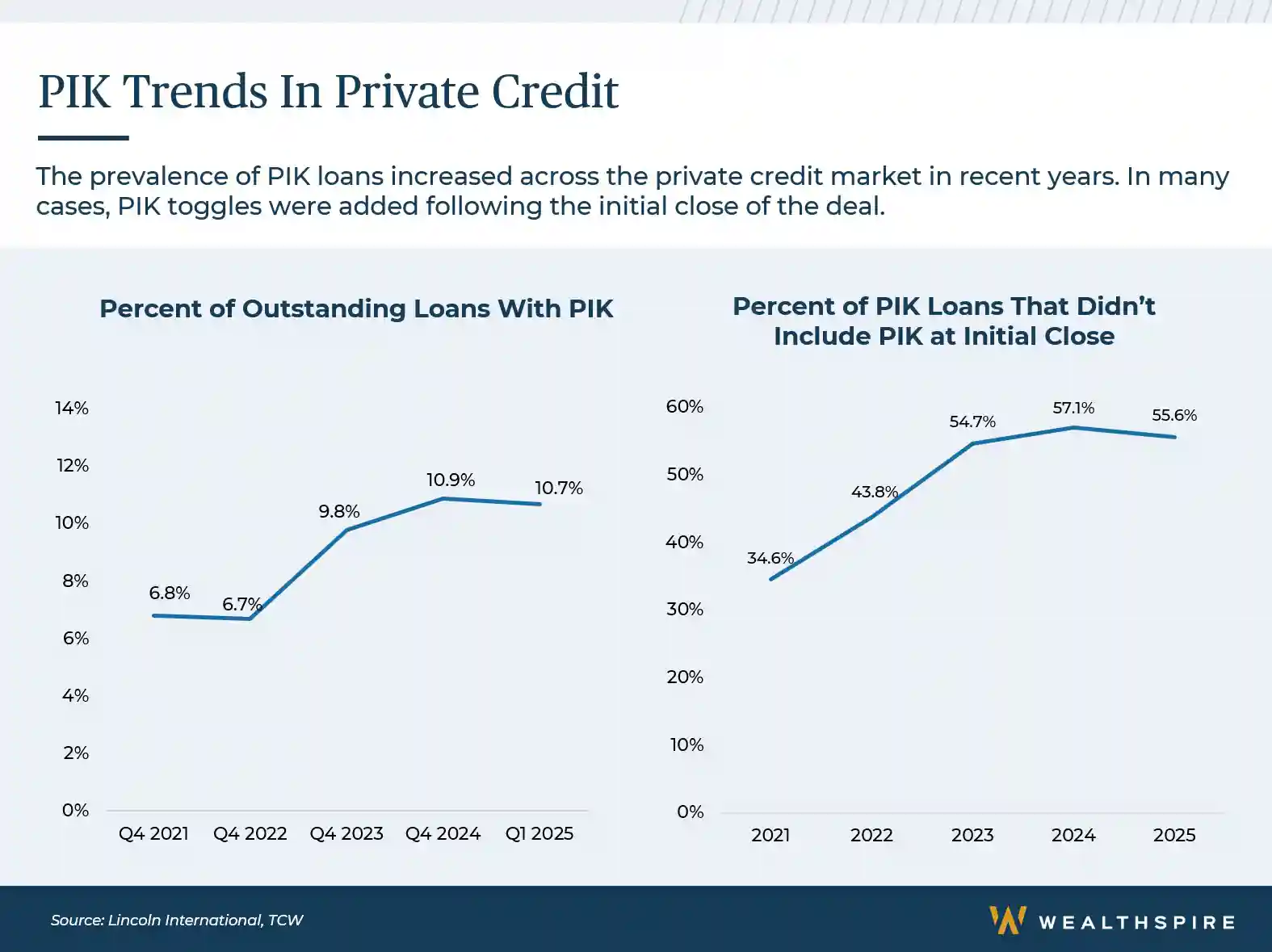
The increased prevalence of PIK was driven by a variety of factors, including the rapid normalization of interest rates that occurred after 2021. As rates moved higher, borrowers with exposure to floating rate debt faced a commensurate increase in debt service burdens and sought relief from lenders which often came in the form of PIK. Generally speaking, increased PIK can be a sign of stress, but should not be taken as an absolute indicator of borrower weakness. PIK serves to provide liquidity relief to borrowers but also increases the lender’s claim size and grants additional negotiating leverage that can be used to strengthen the loan’s covenants. On balance, PIK usage is a signal that the balance of risk and reward is changing, and investors should understand that the environment is becoming more challenging for asset managers.
It should be noted though that the size and diversity of the private credit market aids in mitigating the risk of a large-scale collapse in prices. Private credit spans areas such as direct lending, asset‑based finance, and special/distressed situations. Each of the sub asset classes have their own distinct supply/demand dynamics and underwriting frameworks, and asset managers often specialize in one specific area. Certain parts could become more or less favorable relative to one another over time, but they are distinct enough that the risk of contagion is minimized. The primary risks investors face in the current market are higher competition and lower expected returns; something that is typical of a maturing market.
Conclusion
Because it can’t be traded in a timely fashion, private credit is – by default – a long-term investment. Investors are giving up day‑to‑day liquidity and price discovery in exchange for a higher expected return. That return premium exists because investors are:
- Giving up the option to quickly liquidate their investment
- Embracing structural complexity
- Relying on manager deal sourcing, underwriting and monitoring
Private credit is an inherently risky asset class where outcomes can often rely on manager selection, deal structure, and risk controls. Defaults are inevitable, but disciplined underwriting and robust lender protections are a key defense against permanent impairment of capital.
This is why private credit tends to work best when it is utilized as a strategic allocation (not a tactical sleeve) and funded as part of satellite fixed income rather than core bonds. From a portfolio construction perspective, this involves properly sizing the allocation with consideration for the investor’s near-term liquidity needs and planned uses of capital.
Private credit’s growth put it under a microscope, and recent headlines painted the market with a broad brush. Certain of those headlines proved to be misleading, but others zeroed in on legitimate risks. The market’s evolution can be summarized as follows:
- Yields are moving lower, primarily due to spread tightening and lower base interest rates. As a result, investors are receiving less compensation for risk taking relative to other types of credit.
- Lenders are making concessions to borrowers, as reflected in the increased prevalence of PIK loans. By definition, PIK loans reduce cash flow for investors and pressure dividends.
- The above dynamics combine to reduce the expected return of private credit, while signaling a potential increase in underlying risks.
- Private credit remains an attractive portfolio allocation, but the “easy” returns have already been achieved. In the current market, investors should expect a more balanced relationship between risk and return.
Ultimately, investing is about tradeoffs, and investors must accept certain risks in exchange for appropriate compensation. For many years, private credit offered a return premium that easily justified those tradeoffs. Today, competition is balancing the risk and reward, but that does not negate the role the asset class can play when implemented thoughtfully.