
Purchasing a vehicle is a significant financial decision that requires careful consideration of both personal needs and long-term financial implications. Whether you’re buying your first car or replacing an existing one, understanding the nuances of the car buying process can help you make a more informed and financially sound choice. This guide explores two of the most critical decisions in the process: choosing between a new or used vehicle and determining the most appropriate payment method, whether paying in cash, financing, or leasing.
New vs. Used: Evaluating the Value Proposition
The decision between purchasing a new or used vehicle often hinges on a balance between cost, reliability, and personal preference. New cars offer the appeal of the latest technology, enhanced safety features, and the peace of mind that comes with a full manufacturer’s warranty. They are also free from wear and tear, and buyers can often customize them to their liking. However, these benefits come at a premium. New vehicles depreciate rapidly, often losing 20-30% of their value within the first year, making them a less attractive option for those concerned with long-term value retention.
Used vehicles, on the other hand, present a more cost-effective alternative. Buyers can often find well-maintained, late-model cars at significantly reduced prices. Certified Pre-Owned (CPO) programs offered by many manufacturers add an extra layer of assurance by including extended warranties and thorough inspections. While used cars may lack the latest features and carry a higher risk of maintenance issues, the slower depreciation curve and lower upfront cost make them an attractive option for budget-conscious buyers.
Payment Options: Cash, Financing, and Leasing
Once the vehicle choice is made, the next step is determining how to pay for it. Each payment method: cash, financing, or leasing, carries distinct advantages and trade-offs.
Cash Purchase
Paying in cash is the most straightforward option. It eliminates interest payments, provides full ownership from day one, and removes the burden of monthly car payments. However, it also requires a substantial upfront outlay, which may deplete savings or reduce liquidity that could otherwise be invested for higher returns. This option is best suited for individuals with ample cash reserves who plan to keep the vehicle for many years.
Financing
Financing the purchase allows buyers to spread the cost of the vehicle over several years. This approach makes higher-priced vehicles more accessible and can help preserve cash flow. If the auto loan’s interest rate is less than the expected rate of return on savings or investment accounts over the life of the loan, it may make sense to finance. You then can keep cash otherwise earmarked for the purchase invested to take advantage of the positive arbitrage. In addition, manufacturers and dealers tend to offer additional cash incentives that are tied to financing, so it’s important to keep that in mind when reviewing the pricing of the vehicles that you’re interested in.
Financing the purchase may also have a positive impact on your credit score by adding an additional form of credit to your score’s mix, assuming that you are consistent with on-time payments.
The downside of financing is the added cost of interest over the life of the loan, and the fact that the buyer does not fully own the vehicle until the loan is paid off. It is important to keep in mind that since cars are depreciated assets, financing with the intent of swapping the car out in a short period of time could result in the buyer being “underwater” or having an outstanding loan balance greater than the value of the vehicle. To mitigate these issues, you may consider a larger down payment (a common rule of thumb is 20% of purchase price; however, most buyers put down less, especially if the interest rate on the associated loan is attractive), or by avoiding the frequent trade-in of your cars.
The typical length for a car loan is between 48 and 72 months, but given the increased cost of new vehicles, we’ve seen this figure increase to 84 or even 96 months. It’s important to consider the depreciation of the vehicle and the amount of interest that you’ll pay over the life of the loan before extending the financing period.
Leasing
Leasing offers a different value proposition in which you pay the depreciation of a new vehicle over a set term, usually between two to four years. They generally entice with lower monthly payments and the allure of a new vehicle every few years (assuming you do not buy the car back from the bank at the end of the lease term) while avoiding the “underwater” situation noted above. Leases include warranty protection and may even cover required maintenance during the lease term, reducing out-of-pocket expenses versus buying a used car.
Leasing comes with mileage restrictions, potential fees for excessive wear and tear, and no equity in the vehicle at the end of the term. It is best suited for individuals who prioritize driving newer models and do not mind relinquishing ownership.
It’s also important to think about how to “structure” your lease; you should put as little money up front on a lease as possible. This is often referred to as a “sign and drive” deal, with upfront costs limited to the first month’s payment and fees. Additional money paid up front, including applicable taxes, is forfeited if the car is stolen or deemed a total loss by your insurance company.
A Note on Electric Vehicles
We live in an age where vehicle electrification is booming, with new manufacturers and models on offer each year. With fast-moving innovations and changes in technology, what may be cutting-edge today can be outdated in a few years. For this reason, we see that depreciation curves on electric vehicles tend to be steeper than those of traditional gas-powered or hybrid cars. For this reason, it may make sense to lease an EV rather than buying outright or financing to shift some of the accelerated depreciation risk to a lender rather than bearing it all yourself.
Key Figures to Understand When Leasing
For those considering a lease, it is essential to understand the financial components that determine the total cost of the lease. Two of the most critical figures are the money factor and the residual value.
The money factor is the leasing equivalent of an interest rate. It is typically expressed as a small decimal (e.g., 0.00125), but it can be converted to an approximate annual percentage rate (APR) by multiplying it by 2,400. A lower money factor indicates a better lease rate. While this figure is often negotiable and dealers can mark it up for additional profit, it is also influenced by your credit score and the leasing company’s terms.
The residual value represents the estimated value of the vehicle at the end of the lease term. It is expressed as a percentage of the vehicle’s MSRP (manufacturer’s suggested retail price). A higher residual value generally results in lower monthly payments, as you are only paying for the depreciation that occurs during the lease period. However, it also means the buyout price at the end of the lease may be higher if you choose to purchase the vehicle. The residual value is set by the bank and is not negotiable.
Lease vs. Finance: A Side-by-Side Comparison
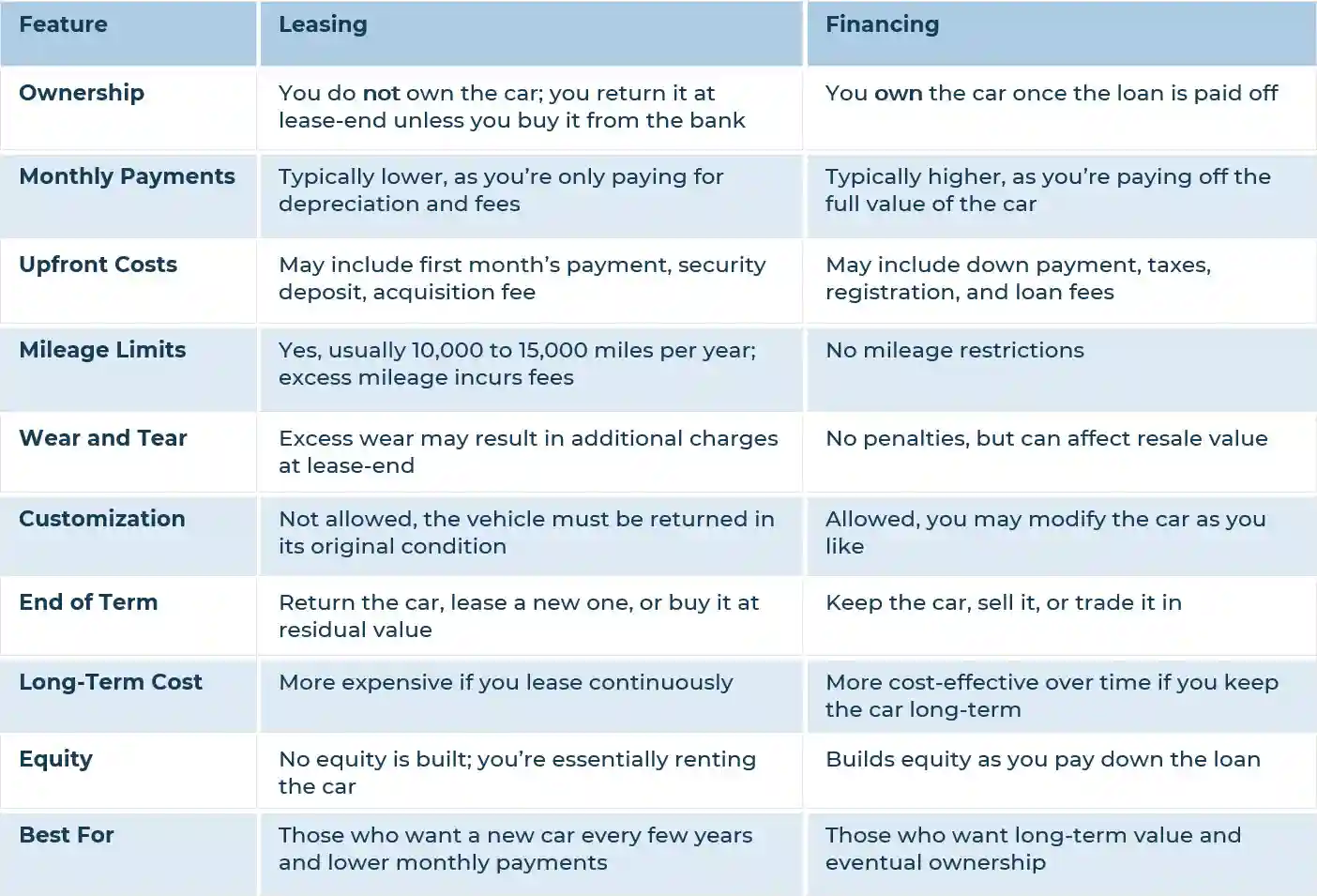
To help clarify the differences between leasing and financing, the table below outlines the key features of each option:
Leaving the City and Getting Back on The Road?
For those transitioning from urban living to the suburbs or rural areas, buying a car after years of relying on public transportation comes with unique considerations. Beyond choosing the right vehicle for your new lifestyle, whether it’s one with all-wheel drive for snowy commutes or extra cargo space for weekend errands, the financial implications extend well beyond the sticker price. First-time buyers should be sure to budget for recurring costs such as insurance premiums, routine maintenance, and registration fees in addition to the expenses to run (whether it’s traditional gasoline, electricity, or a combination of the two) and store the vehicle.
Special Considerations When Purchasing a Classic or Collectible Car
For enthusiasts and investors alike, purchasing a classic or collectible car introduces a unique set of considerations that differ significantly from buying a daily driver. These vehicles are often valued not just for their utility, but for their historical significance, rarity, and potential for appreciation.
- Valuation and Market Research: Unlike standard vehicles, classic cars do not follow conventional depreciation curves. Their value is influenced by factors such as provenance, originality, production numbers, and market trends. Resources like Hagerty’s Valuation Tools, auction house results, and marquee-specific registries can provide insight into fair market value and long-term investment potential.
- Condition and Authenticity: A vehicle’s condition; often categorized as concours, excellent, good, or fair, has a substantial impact on price. Buyers should verify the authenticity of parts, matching numbers (engine, transmission, chassis), and restoration quality. Professional inspections and documentation reviews are essential to avoid costly surprises.
- Storage and Maintenance: Classic cars often require specialized storage to protect against humidity, temperature fluctuations, and UV exposure. Maintenance can be more demanding due to the scarcity of parts and the need for mechanics familiar with vintage systems. These costs should be factored in the total cost of ownership.
- Insurance and Registration: Standard auto insurance may not provide adequate coverage for collectible vehicles. Specialty insurers offer agreed-value policies that reflect the car’s appraised worth. Additionally, some states offer historic or antique vehicle registration, which may come with usage restrictions.
- Liquidity and Exit Strategy: While some classic cars appreciate overtime, the market can be illiquid. Selling may require participation in auctions or consignment with specialty dealers. Buyers should consider their time horizon and whether the purchase is driven by passion, investment, or both.
Purchasing a classic car can be deeply rewarding, but it demands a more nuanced approach than buying a modern vehicle. Due diligence, expert guidance, and a clear understanding of ownership responsibilities are key to making a sound investment. Read more on investing in collectible cars here.
Helpful Resources for Car Buyers
In today’s digital landscape, several online platforms can simplify and enhance the car buying experience. These tools provide transparency, pricing insights, and negotiation leverage, empowering buyers to make more informed decisions.
- Edmunds.com offers comprehensive vehicle reviews, pricing tools, and cost-to-own calculators. It’s particularly useful for comparing models and understanding long-term ownership costs.
- TrueCar provides real-time market pricing data based on what others have paid for similar vehicles in your area. It’s a valuable resource for negotiating fair prices with dealers.
- LeaseHackr is a community-driven platform focused on leasing. It features deal calculators (including a lease vs. buy section), discussion forums, and expert insights that help users evaluate lease offers and identify promotions.
Leveraging these platforms can help demystify the car buying process, whether you’re purchasing new or used, or exploring lease options.
Conclusion
The car buying process is multifaceted, with each decision carrying financial and practical implications. Choosing between a new or used vehicle involves weighing the benefits of modern features and warranties against cost savings and depreciation. Similarly, selecting a payment method requires a clear understanding of one’s financial situation, the overall cost of ownership for the vehicle, and one’s long-term goals. By approaching these decisions strategically and utilizing trusted resources, buyers can align their vehicle purchase with both their lifestyle and financial well-being.

Wealthspire Advisors LLC and certain of its affiliates are separately registered investment advisers. © 2026 Wealthspire
This material should not be construed as a recommendation, offer to sell, or solicitation of an offer to buy a particular security or investment strategy. The information provided is for informational purposes only and should not be relied upon for accounting, legal, or tax advice. While the information is deemed reliable, Wealthspire cannot guarantee its accuracy, completeness, or suitability for any purpose, and makes no warranties with regard to the results to be obtained from its use.
Wealthspire and its representatives do not provide legal or tax advice, and Wealthspire does not act as law, accounting, or tax firm. Services provided by Wealthspire are not intended to replace any tax, legal or accounting advice from a tax/legal/accounting professional. The services of an appropriate professional should be sought regarding your individual situation. You should not act or refrain from acting based on this content alone without first seeking advice from your tax and/or legal advisors.
Certain employees of Wealthspire may be certified public accountants or licensed to practice law. However, these employees do not provide tax, legal, or accounting services to any of clients of Wealthspire, and clients should be mindful that no attorney/client relationship is established with any of Wealthspire's employees who are also licensed attorneys.
Please Note: Limitations. The achievement of any professional designation, certification, degree, or license, recognition by publications, media, or other organizations, membership in any professional organization, or any amount of prior experience or success, should not be construed by a client or prospective client as a guarantee that he/she will experience a certain level of results or satisfaction if Wealthspire is engaged, or continues to be engaged, to provide investment advisory services, nor should it be construed as a current or past endorsement of Wealthspire by any of its clients or a third party.
Registration of an investment advisor does not imply that Wealthspire or any of its principals or employees possess a particular level of skill or training in the investment advisory business or any other business.
Certified Financial Planner Board of Standards, Inc. (CFP Board) owns the certification marks CFP®, CERTIFIED FINANCIAL PLANNER®, and CFP® (with plaque design) in the United States, which it authorizes use of by individuals who successfully complete CFP Board's initial and ongoing certification requirements.