2026 federal tax rules and planning opportunities
What changed for 2026
The federal annual limit for K-12 qualified withdrawals increased to $20,000 per beneficiary. The expanded K-12 expense list and qualified postsecondary credential expenses remain available, and 529-to-ABLE rollovers are no longer scheduled to expire.
 Important
This guide summarizes federal rules. State tax treatment, recapture rules and plan administration can differ. Confirm the beneficiary, expense date, school or program eligibility, and state conformity before taking a distribution.
Higher Education Expenses
For an eligible college, university, graduate school, vocational school, or other postsecondary institution that participates in a federal student aid program, qualified uses generally include:
-
Tuition and fees required for enrollment or attendance.
-
Books, supplies, and equipment required for courses or enrollment.
- Computer hardware, peripheral equipment, educational software, internet access, and related services used primarily by the beneficiary while enrolled.
- Equipment primarily for entertainment does not qualify.
- Special-needs services incurred in connection with enrollment or attendance.
- Room and board when the beneficiary is enrolled at least half-time. The maximum is generally the school’s published cost-of-attendance allowance, or the actual amount charged for school-owned or operated housing if higher. Can live off of campus and can cover up to the school’s published cost-of-attendance.
- NOTE: If the 529 beneficiary receives a scholarship, you can withdraw that scholarship amount from the 529 plan without the 10% penalty and would only have to pay ordinary income taxes on the earnings. Note that the withdrawal must take place during the school year in which the scholarship is received/applied.
Eligible institution check
Use the U.S. Department of Education Federal School Code Search or ask the institution whether it is eligible to participate in federal student aid programs before relying on 529 treatment.
K-12 Expenses for 2026
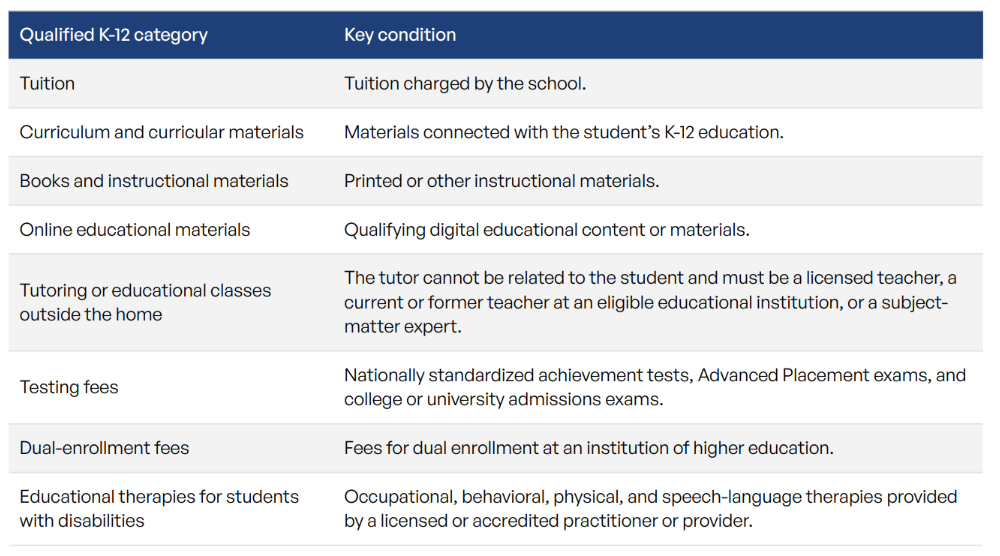
$20,000 annual federal limit. The limit applies per beneficiary, aggregated across all 529 accounts, for expenses connected with attendance or enrollment at a public, private, or religious elementary or secondary school.
Career, credential and debt-related uses
Registered apprenticeship programs
529 funds may cover fees, books, supplies, and equipment required to participate in an apprenticeship program registered and certified with the U.S. Secretary of Labor.
Recognized postsecondary credential programs
Qualified postsecondary credentialing expenses can include:
-
Tuition, fees, books, supplies, and equipment required for enrollment or attendance.
-
Testing fees required to obtain or maintain the credential.
-
Continuing-education fees required to maintain the credential.
Eligible credentials are limited by federal definitions and can include certain industry recognized credentials, registered apprenticeship certificates, federal or state occupational, or professional licenses, and recognized postsecondary credentials under the Workforce Innovation and Opportunity Act. Verify the specific program before distributing funds.
Student loan repayment
-
Up to $10,000 lifetime per individual may be used for principal or interest on a qualified education loan.
-
The beneficiary’s sibling can also receive up to a separate $10,000 lifetime amount from a 529 plan, subject to the rules.
-
Student loan interest paid with a tax-free 529 distribution cannot also be claimed for the student loan interest deduction.
Rollover options
529 to Roth IRA for the beneficiary
A direct trustee-to-trustee transfer may be federally tax-free when all requirements are satisfied:
-
The 529 account has been open for at least 15 years as of the rollover date.
-
The rollover is made to a Roth IRA in the name of the 529 beneficiary.
-
The total lifetime rollover amount does not exceed $35,000.
-
The annual rollover is limited by the applicable annual Roth IRA contribution limit and other IRA contribution rules.
-
Beneficiary must have earned income to complete Roth IRA contribution.
-
The rollover cannot include contributions, or earnings on those contributions, made during the five-year period ending on the distribution date
529 to ABLE account
A limited rollover may be made to an ABLE account for the 529 beneficiary or an eligible member of the beneficiary’s family. The rollover counts toward the ABLE account’s applicable contribution limit. Federal law now permits these rollovers beyond 2025; state and plan procedures should still be confirmed.
Planning note
A beneficiary change, account history, earned compensation and prior IRA contributions may affect the available rollover amount. Coordinate with the 529 administrator and tax advisor before processing.
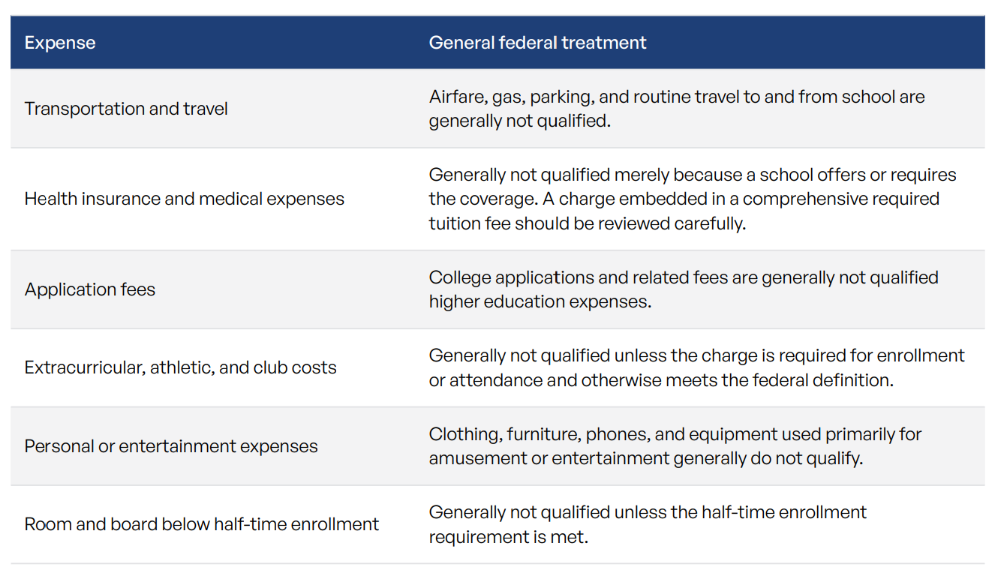
Expenses that generally do not qualify
2026 tax and contribution notes
-
Federal contributions are not deductible. Earnings grow federal income-tax deferred, and qualified distributions are generally federal income-tax free.
-
The 2026 federal annual gift-tax exclusion is $19,000 per donor, per recipient. A special five-year election can allow up to $95,000 per donor, or $190,000 for a married couple making equal gifts, to be treated ratably over five years. Form 709 may be required and later gifts during the five-year period can affect the calculation.
-
Nonqualified distributions generally cause the earnings portion to be included in income and may trigger a 10% additional federal tax. Exceptions to the additional tax can apply, including certain situations involving scholarships, death, disability, or attendance at a U.S. military academy, but income tax on earnings may still apply.
- Do not use the same expense both for a tax-free 529 distribution and for an education credit, tax-free scholarship or other tax-favored benefit. Coordinate expenses before year-end.
Distribution checklist
-
Confirm the beneficiary school, apprenticeship, or credential program expenses are qualified for 529 plan distributions.
-
Match the distribution to qualified expenses incurred in the same tax year.
-
Retain invoices, receipts, enrollment status, the school’s room-and-board allowance, and proof of payment.
-
Pay the school or vendor directly, or reimburse the account owner or beneficiary promptly with a clear paper trail.
-
Consider state tax treatment and any prior state deduction or credit recapture.
- Review Form 1099-Q and coordinate with Form 1098-T, scholarships, and education credits.
Important disclosure
This material is for general educational purposes and reflects federal rules available as of September 4, 2026. It is not tax or legal advice. Tax laws, state conformity and plan procedures may change. Consult the client’s tax or legal advisor and the applicable 529 plan administrator before implementing a strategy.