If the first half of 2026 asked whether the economy could absorb an oil shock, the third quarter asked a trickier question: can the economy also absorb rapidly rising interest rates? Over the summer, the Federal Reserve raised interest rates for the first time since 2023 under its new Chair, Kevin Warsh, the 10-year Treasury yield climbed above 5% for the first time since 2007, Brent crude returned to roughly $100 per barrel, and U.S. diesel prices hit a record. The midterm elections, meanwhile, are now only weeks away.
Despite the risks, the S&P 500 reached a record high in mid-August and remained close to it into the end of September, carried by exceptionally strong corporate earnings. Markets are balancing a familiar tension between an economy that is growing, everyday costs that are not fully cooperating, and a flurry of headlines that perpetually raise angst. To make sense of it, we look back to a summer when many of the same ingredients dominated the headlines, while trying to understand what that period can, and cannot, teach investors today. The temptation is to view 2026 through a 1970s lens. While today's oil shock and tensions involving Iran create clear historical echoes, the economy, the energy market, and the Federal Reserve enter this period from a fundamentally stronger position than they did fifty years ago.
The Long Shadow of the 1970s
The events of the late 1970s are often remembered as an isolated crisis, though in reality, they were the culmination of a decade of rising inflation, energy shocks, and fading confidence in economic policy. The first warning came in 1973, when the Arab oil embargo exposed the developed world's dependence on imported energy and sent oil prices sharply higher. Six years later, the Iranian Revolution disrupted one of the world's largest oil producers, reigniting inflation fears and pushing oil prices up another 60% by the summer of 1979. Americans waited in long lines at gas stations, inflation was accelerating into double digits, and confidence in policymakers was fading.
The parallels to today are difficult to ignore. Once again, investors are focused on the Middle East, the security of global energy supplies, and the possibility that geopolitical tensions involving Iran could spill into oil markets. Yet the similarities should not obscure the differences. In the 1970s, oil shocks struck an economy that was far more energy-intensive, heavily dependent on imported crude, and already struggling with entrenched inflation expectations. Today, the United States is one of the world's largest energy producers, energy consumption per dollar of GDP is dramatically lower, and inflation expectations remain far better anchored than they were fifty years ago. The transmission mechanism is similar but the degree of vulnerability is not.
Still, the most enduring lesson of the 1970s has less to do with oil than with credibility. Throughout much of the decade, policymakers responded to each economic slowdown with easier monetary policy, only to see inflation reemerge with greater force. By the summer of 1979, confidence in the Federal Reserve became scarce. In August of that year, Paul Volcker was sworn in as Fed Chair and soon began one of the most aggressive inflation-fighting campaigns in modern history. That same month, BusinessWeek published its famous "Death of Equities" cover, reflecting a prevailing belief that stocks had become a permanently disappointing investment. The pessimism was understandable as the previous decade delivered little in the way of real returns while inflation steadily eroded purchasing power.
The medicine that followed was painful with inflation peaking near 15%, the economy enduring back-to-back recessions, and the 10-year Treasury yield approaching 16%. Yet the restoration of monetary credibility became the foundation for one of the strongest periods of wealth creation in modern financial history. The investors who ultimately benefited most were not those who perfectly anticipated the turning point. They were the ones willing to remain invested while the future looked least promising. Markets often focus on the similarities between the present and the past, but long-term outcomes are frequently determined by the differences.
Conflict involving Iran is disrupting the world’s oil supply, a new Fed Chair has taken office in the middle of an energy shock, and the central bank faces public pressure, including from the White House, to keep rates low. Chair Warsh’s answer in September was clear - the Fed raised its policy rate by a quarter point to a range of 3.75% to 4.00%, with all twelve voting members in favor, and Warsh told reporters that inflation is too high and has been for too long.
The differences might matter more than the similarities, however. Headline inflation rose 3.4% in August over the past year, a fraction of the double-digit readings experienced during two separate episodes in the 1970s, and core inflation, which excludes food and energy prices, was up just 2.4%. Today’s price pressure is concentrated where you would expect in an oil shock: energy prices are up 16.3% from a year ago, led by gasoline at 27.4%, though the economy is also far less exposed than it was. The amount of oil the U.S. uses to produce each dollar of output has fallen steadily since 1980, households entered this shock spending a near-record-low share of their budgets on energy, and the U.S. is now the world’s largest crude oil producer.
Perhaps the most important difference is timing. In 1979, the Fed was trying to win back credibility that was already lost. In 2026, it is trying to protect credibility it still has. Warsh described the September move as removing “a dose of accommodation” rather than slamming on the brakes, and it comes with the job market on solid footing: employers added 133,000 jobs in August, followed by 29,000 in September, and the unemployment held at 4.2%. Still, households feel the energy spike, and their expectations for inflation over the next year rose to 4.6% in September. Keeping expectations from becoming entrenched was the central lesson of the 1970s, and one that policymakers who lived through the “transitory” debate of 2021 have not forgotten.
The Bond Market’s Verdict
If the Fed’s decision was the headline, the bond market is delivering a less than favorable verdict. The 10-year Treasury yield, which ended June at 4.46%, rose to 5.3% at the end of September, its highest level since 2007, while the 30-year yield hit 5.6%. For households, the move shows up in borrowing costs, with mortgage rates around 7% at a time when affordability is already the defining issue of the election season.
Three forces drove the move. The first is policy: after the September meeting, futures markets implied roughly three more quarter-point rate increases over the next year. The second is uncertainty. Investors are again demanding extra compensation, known as the term premium, for lending to the government for longer periods when the paths of inflation and deficits are hard to forecast. The third is supply. The Treasury continues to finance large deficits, and companies building artificial intelligence (AI) infrastructure are borrowing heavily in the same market.
For investors, rising yields cut both ways. In the short run, bond prices fall when yields rise, and that weighed on fixed income returns this quarter. Over longer periods, however, the yield an investor starts with is historically the single best predictor of what a high-quality bond portfolio will earn. As we wrote at the start of the year, starting points matter. The broad investment-grade bond market now yields roughly 5.5%, enough that yields could rise by close to another percentage point over the next year before a typical core bond portfolio would lose money.
The lesson of 1979 applies here as well. Bond investors who locked in yields near their peak were rewarded for decades, but no one could identify that peak in real time, and those who waited for certainty often missed it. We are not predicting that yields peaked. Our point is simpler: Treasury yields are the highest in nearly two decades, and that income tends to work in investors’ favor over time. We continue to favor owning that yield, diversifying within the core of bond portfolios (including Treasury Inflation-Protected Securities as a hedge against energy price pressure), and using municipal bonds where tax brackets make them compelling.
The Engine Under the Hood
Why have stocks held up so well against this backdrop? The short answer is earnings. Analysts expect S&P 500 companies to report third-quarter earnings growth of roughly 29% from a year ago, which would mark a third consecutive quarter above 25%. Unusually, estimates rose during the quarter rather than drifting lower, as they typically do. Even with the index near record highs, the market’s forward price-to-earnings ratio, a measure of what investors pay for each dollar of expected profit, stands at about 19x, slightly below its five-year average. In other words, prices have largely followed profits rather than running ahead of them.
The conversation around AI is also maturing. The question is shifting from whether companies will spend on AI infrastructure to whether that spending will earn attractive returns and how it will be financed. The largest cloud and AI companies are relying more on borrowing, and in July, Fed staff noted that the extra yield lenders demand from these companies widened relative to other high-quality corporate borrowers. None of this makes us bearish on the theme, but it does reinforce a theme from last quarter’s letter: from canals and railroads to the internet, periods of heavy infrastructure investment transform the economy even when they did not reward every company doing the building, which is why diversification remains essential.
Looking Ahead
The fourth quarter brings a crowded calendar. The Fed meets again on October 28, third-quarter earnings season begins in mid-October, voters go to the polls on November 3, and Congress faces a December 11 funding deadline. Any of these could stir volatility, as could a changing of tension with Iran or reopening of Hormuz. The November 3 elections will decide control of a closely divided Congress where Republicans hold a narrow 219–214 majority in the House and prediction markets favor Democrats, while the Senate appears more competitive. With inflation still elevated and borrowing costs rising, the price of gasoline, groceries, and a mortgage is not an abstraction for voters. The president’s party historically loses an average of 25 House seats and three Senate seats in midterm elections. What happens after the votes are counted has been far more encouraging: the S&P 500 has been higher 12 months after every midterm election since 1950, regardless of which party prevailed.
So far, midterm-year volatility has been muted in 2026, as strong earnings and AI investment overshadowed political uncertainty, and though that could change in the weeks ahead, we should not be surprised by a bumpier path into November. Even so, we would caution against making portfolio decisions based on anticipated election outcomes. Over any meaningful horizon, earnings, interest rates, and the discipline of a well-built plan matter far more than which party controls Congress. We are approaching the calendar with the same principles that served our clients through this year’s twists: stay balanced, own the income that higher yields now provide, diversify globally and within asset classes, and manage liquidity with intent.
In the summer of 1979, the prevailing wisdom held that inflation broke the financial markets for good. What followed instead was a demonstration of how much a credible central bank, and a patient investor, can accomplish. Credibility is expensive to earn and can be even more expensive to lose which is why the Fed chose to raise in the interest of slowing prices. For long-term investors, that choice, and the higher yields that came with it, may prove to be less a warning than an opportunity. We thank you for your continued trust and look forward to navigating the quarters ahead together.
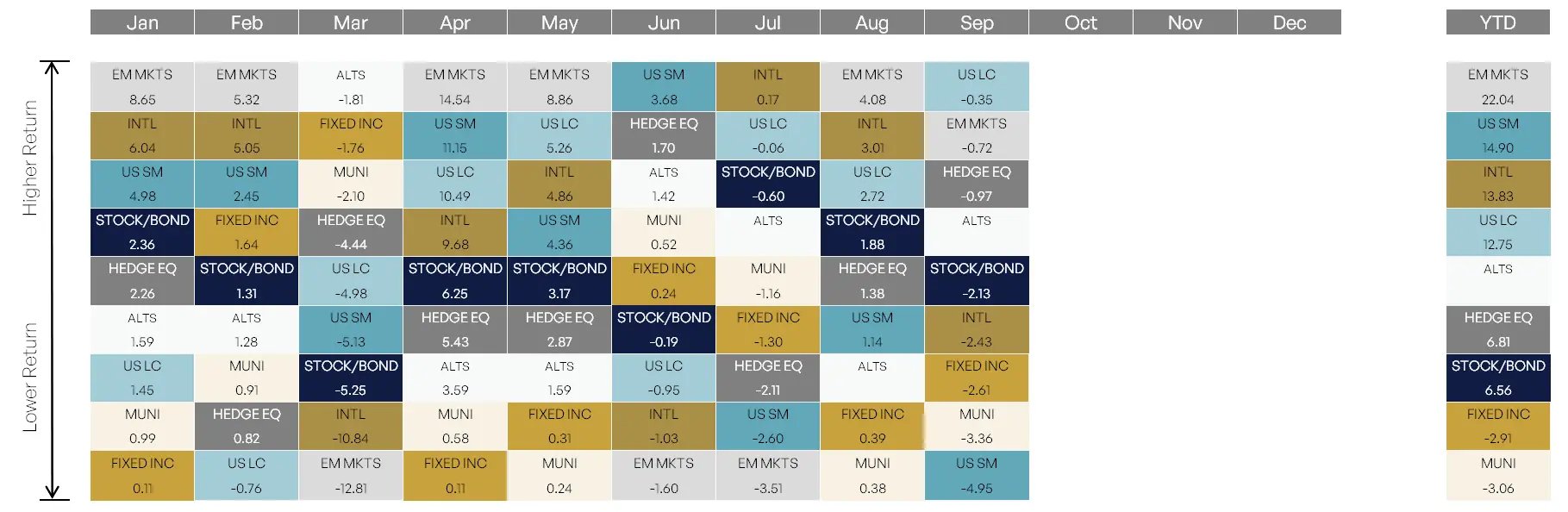
Markets
- Stock markets were mixed in the quarter, with U.S. large cap and developed international stocks performing positively. Elsewhere, mid-cap and small cap stocks were both down following a poor end to summer and weak performance throughout September. Performance for smaller companies was closely tied to rising interest rates and the headwinds associated with increased financing costs. On a year-to-date basis, emerging markets and small cap stocks are the top performers of the equity market, with only mid-cap stocks up less than 10%.
- Bond markets were down noticeably in the third quarter, given questions about the likely path of the Federal Reserve in coming meetings and stubborn inflationary pressure that refused to abate. The Bloomberg U.S. Aggregate Bond Index is down 2.9% along with the Bloomberg Muni 1-10 Year Index that is down 3.1%. The Aggregate Bond Index finished the quarter with a yield to worst of 5.56% and the Muni 1-10 Year Index was 4.32%.
- Commodity market performance picked back up during the quarter as oil prices jumped towards $100/barrel. The Bloomberg Commodity Index rose 5.6% and remains up 32% year-to-date. Commodity markets also saw strong price appreciation across agricultural commodities, notably coffee, corn, cotton, sugar, and wheat.

Wealthspire Advisors LLC and certain of its affiliates are separately registered investment advisers. © 2026 Wealthspire
This material should not be construed as a recommendation, offer to sell, or solicitation of an offer to buy a particular security or investment strategy. The information provided is for informational purposes only and should not be relied upon for accounting, legal, or tax advice. While the information is deemed reliable, Wealthspire cannot guarantee its accuracy, completeness, or suitability for any purpose, and makes no warranties with regard to the results to be obtained from its use.
Wealthspire and its representatives do not provide legal or tax advice, and Wealthspire does not act as law, accounting, or tax firm. Services provided by Wealthspire are not intended to replace any tax, legal or accounting advice from a tax/legal/accounting professional. The services of an appropriate professional should be sought regarding your individual situation. You should not act or refrain from acting based on this content alone without first seeking advice from your tax and/or legal advisors.
Certain employees of Wealthspire may be certified public accountants or licensed to practice law. However, these employees do not provide tax, legal, or accounting services to any of clients of Wealthspire, and clients should be mindful that no attorney/client relationship is established with any of Wealthspire's employees who are also licensed attorneys.
Please Note: Limitations. The achievement of any professional designation, certification, degree, or license, recognition by publications, media, or other organizations, membership in any professional organization, or any amount of prior experience or success, should not be construed by a client or prospective client as a guarantee that he/she will experience a certain level of results or satisfaction if Wealthspire is engaged, or continues to be engaged, to provide investment advisory services, nor should it be construed as a current or past endorsement of Wealthspire by any of its clients or a third party.
Registration of an investment advisor does not imply that Wealthspire or any of its principals or employees possess a particular level of skill or training in the investment advisory business or any other business.
Certified Financial Planner Board of Standards, Inc. (CFP Board) owns the certification marks CFP®, CERTIFIED FINANCIAL PLANNER®, and CFP® (with plaque design) in the United States, which it authorizes use of by individuals who successfully complete CFP Board's initial and ongoing certification requirements.