It’s always difficult to write these letters during periods of geopolitical upheaval. On one hand, we remain steadfast in our belief that geopolitical events rarely require reactive changes in long‑term portfolio strategy. On the other hand, the facts steering markets are shifting rapidly, and framing the consequences of war in terms of asset prices can feel inadequate against the impact to entire generations and societies.Still, markets rarely grant the luxury of pause, and the first quarter of 2026 was a perfect encapsulation of this unfortunate reality. On February 28th, as the United States and Israel launched military strikes on the Iranian mainland, a market that previously found strength from the evolution of the AI capex trade abruptly recalibrated. Overnight, focus shifted toward the vulnerability of the Strait of Hormuz and the economic consequences of its closure. With the market’s focus now centered on control of this critical global trade artery, history offers a useful lens for understanding where events may lead next.
Lessons from the Suez Canal
In the fall of 1956, a coalition of Western powers (Britain, France, and Israel) launched Operation Musketeer, a military campaign to recapture the Suez Canal after Egyptian President Gamal Abdel Nasser nationalized the passage. At the time, the canal was the world’s most critical maritime chokepoint, serving as the primary artery connecting European markets to Middle Eastern oil and Asian trade. Militarily, Operation Musketeer worked, though strategically it did not. The coalition technically won on the battlefield but lost because of political and economic pressure on the home front. The crisis demonstrated, with painful clarity, that access to a single maritime corridor could carry wide ranging impacts on currencies, government, alliances, and markets. Seventy years later, the United States finds itself in strikingly similar circumstances.
Operation Epic Fury achieved its immediate military aims in Iran with leadership disrupted, missile and drone facilities degraded, and uranium stockpiles reportedly difficult to access by the regime. But the broader strategic goals that these tactical elements signal – an open Strait of Hormuz, more U.S.-friendly Iranian leadership, and regional stability – have not been met. The Strait remains effectively closed, and what was once a potential tail risk scenario has, in the span of weeks, become the largest disruption to world energy supply in decades.
The Hormuz Problem
The economic fallout from Suez was swift and severe, particularly for Britain. The closure of the canal from October 1956 through March 1957 severed the primary shipping lane between Europe and Asia, contributing to oil shortages that rippled across Western Europe. Petrol was rationed and the crisis accelerated the end of British Prime Minister Anthony Eden’s government. The financial contagion was compounded by the fact that markets were caught largely off guard with few adequately pricing the risk that a regional military conflict could sever a global trade artery so completely.
Today, the Strait of Hormuz crisis carries comparable, and in some dimensions, greater economic stakes. Before its effective closure, roughly 20 million barrels of oil per day flowed through the strait, representing approximately 18% of global supply, alongside an estimated 20% of global liquid natural gas.i The Dallas Fed estimates that this supply disruption is three to five times larger in magnitude than the oil shocks of 1973 or 1990. As a result of its closure, WTI crude oil prices rose 50% from pre-war levels, and non-U.S. oil grades rose by 100% or more over the first quarter. Elsewhere, jet fuel more than doubled year-over-year, and secondary supply chain disruptions spread into plastics, aluminum, fertilizers, synthetic fibers, and industrial chemicals. The widespread impacts underscore that this event carries systemic risk and is not merely an energy event.
The economic toll for such disruption is acute. The Dallas Federal Reserve recently estimated that if the Strait remained closed for the remainder of 2026, it would reduce real global GDP growth by 1.3%, roughly equivalent to Mexico’s entire economy going dark for a year.ii
Motivated Resolution
In the U.S., as mid-term elections are nearing, the voting topic du jour remains affordability. In November of last year, elections were held in Georgia, New Jersey, New York City, and Virginia. A consistent theme that emerged was voters’ concerns about affordability of housing, energy, food, and the growing cost of everyday life. Exit polling confirmed strategists’ suspicions that cost-of-living outranked crime, immigration, and other key topics as voters’ top issue. That issue, however, is now colliding with a more complicated economic reality. Gasoline prices and inflation are not abstract policy debates. They are felt at every fill-up and often find their way into voting booths. Like with Britain in 1956, the mechanism for catalyst is less likely to be the battlefield and more likely to be political pressure at home.
The challenge remains finding a credible exit. According to the associated press, Iran’s terms for peace include per-ship tolls on Strait passage, their right to enrich uranium and pursue a nuclear program, and reparations for damages sustained, among others. These terms suggest Tehran believes leverage is on its side.
What We’re Watching
Two signals will define the long-term impact of this conflict.
The first is whether Iran tests its leverage over the Strait of Hormuz. Before this conflict, the idea of an Iranian toll on commercial vessels was not a serious risk scenario. It is now. Nearly 140 ships transit the Strait each day. Iran has floated a $2 million levy per vessel. If implemented, that generates over $100 billion in annual revenue, nearly double its current oil export income of $53 billion.iii The financial incentive is real, and a permanent toll regime would redirect global commodity flows toward Chinese-aligned economies and create lasting friction for Western markets.
The second signal is the extent of damage to energy infrastructure. A swift resolution could reopen the Strait within weeks, but physical damage to production and refining facilities is a different problem. Repairs take months, sometimes years. If supply is forced to contract structurally with no credible alternative to fill the gap, the inflationary pressure this conflict already created may not resolve when the fighting does.
Green Shoots
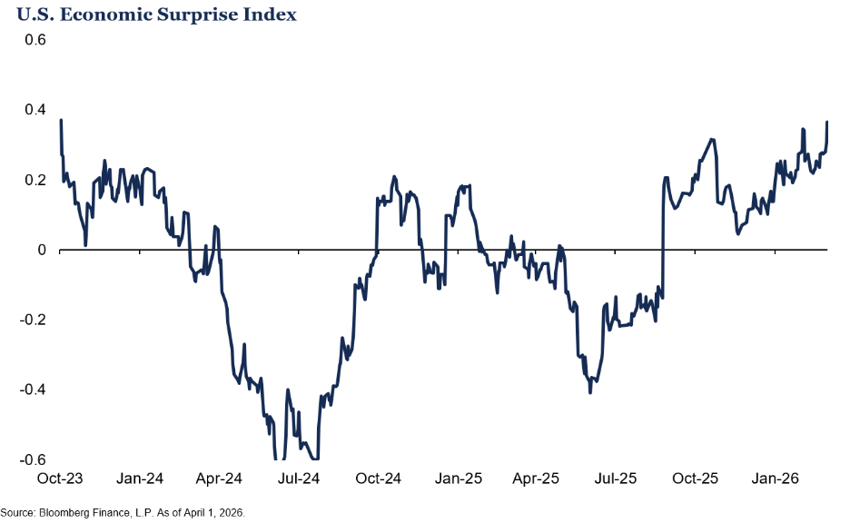
The stakes are high, but on balance, we see genuine reasons for measured optimism. Earnings growth is broadening, powered by AI and defense spending. The Bloomberg Economic Surprise Index sits near its highest level since 2023, and shelter costs, a stubborn driver of core inflation, continue to moderate. Critically, a soft labor market reduces pressure on the Fed to respond to inflationary pressure by tightening financial conditions. Collectively, these conditions buy time for a diplomatic resolution and create a backdrop under which one can succeed.
The Suez Crisis resolved in weeks once political will collapsed under domestic pressure. We believe this conflict has the potential to follow a similar arc. The forcing function exists, the motivation is acute, and the economic backdrop remains resilient enough to absorb the shock while a resolution takes shape. As a result, we are remaining disciplined and watching evolving conditions closely. Risks remain, chiefly around infrastructure damage and willingness to negotiate in good faith. But it’s important to note that both the market and the economy entered 2026 with considerable momentum, providing insulation against any lasting economic impacts stemming from the conflict.
Markets
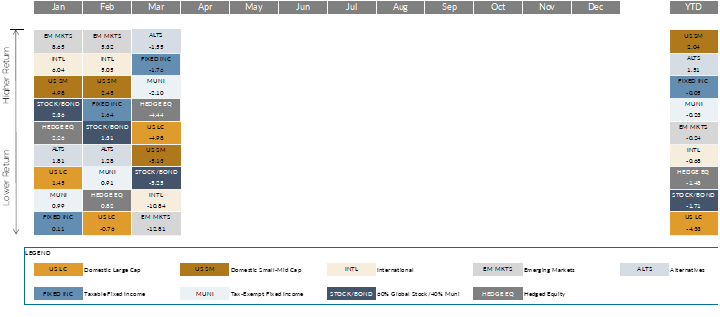
- Global stocks retreated in March and the first quarter after a strong start in January and February. The S&P 500 ended the quarter down 4.3%, and the Nasdaq Composite fell 6.9%, their worst quarter since 2022. The Iran conflict dominated sentiment from its onset on February 28th. The quarter closed on an encouraging note as green shoots of resolution emerged, and the S&P 500 surged 2.9% on March 31st, its best single trading day of 2026.iv
- In the U.S., technology was the hardest-hit sector. Software stocks pulled back on concerns that AI investment would erode their competitive value. Over the last five years, software as a service traded at a 50% premium to the broader market.v That premium has been erased over the last two quarters. The weakness drove a broad rotation into value stocks across every market-cap tier. Large-cap growth lost 9.8%, while large-cap value gained 2.1%. Small-cap value led all segments, rising 5%, as investors sought defensively positioned, attractively priced companies.
- International stocks held up well by comparison, though March returns softened as the Iran conflict came into focus. For the quarter the MSCI EAFE fell just 1.2% and MSCI Emerging Markets slipped only 0.2%, both comfortably outpacing U.S. markets.
- Bond markets offered modest stability. The Bloomberg U.S. Aggregate Bond Index was flat, TIPS rose 0.3%, and high yield bonds dipped just 0.5%, cushioned by income. Rates climbed through the quarter on inflation concerns tied to higher energy prices. Markets have largely erased expectations for a Fed cut in 2026, a sentiment we think may be overdone in the short term.
 Source: Morningstar and Bloomberg Finance L.P. (data as of 3/31/2026)